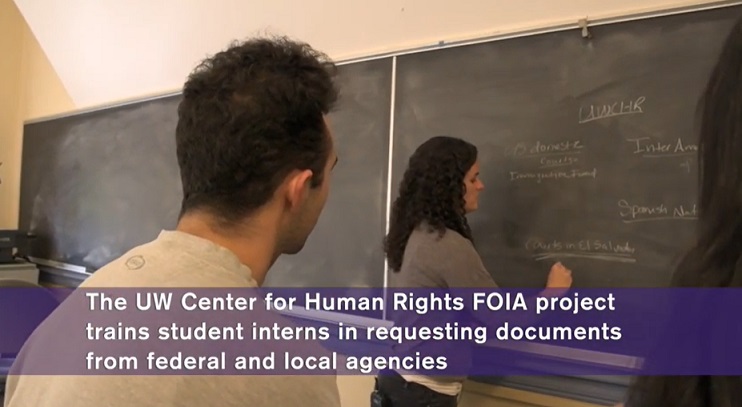
I have over four years of teaching in the university setting, as a teaching assistant, and as a sole-instructor. I also have trained over 50 interns on how to file FOIA requests, and provide career and academic mentorship to interns and students.
In the Classroom
I designed my own course, International Justice on Trial, for the Law, Societies, and Justice undergraduate program, and due to its success, was asked to teach it a second time. The course analyzes the effectiveness in using international human rights trials to achieve justice, while also critically engaging ideas about what “justice” means, and exploring alternative forms of justice. (Syllabus available upon request.)
I also taught my own course, Human Rights in Latin America, after serving four years as a teaching assistant for the course. We explore the authoritarian period of modern Latin American history, though the development of the human rights movement in the 1960s and 1970s, to current day human rights challenges among immigrant communities in the U.S., and emerging human rights concerns with corporations globally. Through innovative assignments, students apply theory to solve real world human rights problems. (Syllabus available upon request.)
Pedagogical Developments
I develop various teaching tools to ensure students obtain skills for excelling in their academic work, in my class, and in other classes. I created a schema for reading academic papers for students to use generally (available here), as well as individual reading guides for course readings.
In an effort to address equity in education and to open my classroom to diverse forms of knowledge production, I created a set of guidelines for students to cite personal experience and interviews in their research papers. The development of these guidelines were inspired by classroom discussion and Indigenous scholarship. These guidelines are a work in progress with current and past students. (Draft available upon request.) I presented these guidelines at the University of Washington 2019 Praxis Conference, “Anti-Racist Pedagogy: Visions and Practices for Institutional Change,” the proceedings for which can be found here. (A copy of presentation slides available upon request.)
Diversity & Inclusion
I obtained specific training for working with undocumented students, and students with disabilities, and have expanded my engagement with diversity & inclusion strategies through applying decolonizing methodologies in my classroom. I develop innovative assignments, course material, and evaluation strategies based on my study of Indigenous scholarship regarding knowledge production. I provide a wide variety of material, allowing for different ways of learning and evaluating students’ knowledge. I engage students through a variety of activities including guest speakers, documentary films, podcasts, declassified documents, popular magazine articles, social media posts, and poetry alongside more standard texts in order to be inclusive of a range of learning styles, as well as a variety of voices and backgrounds. I seek out material that centers the voices of marginalized groups so that all students have the opportunity to connect the material to their own lives.
Beyond my work with students in the classroom, I provide academic and career mentorship, having worked with a number of students over several years. We discuss challenges students face navigating higher education as students of color, from a working-class background, as undocumented immigrants and with undocumented family members, and students with disabilities. I work with students to explore career paths, find internships, opportunities to work and study abroad, and the basics of networking.
I served as adviser and mentor to the Spring 2018 Jackson School of International Studies, Latin American and Caribbean Studies Independent Study project to research Forensic Anthropology and Human Rights in Guatemala. Students have gone on to continue this undergraduate student research group for several years, for which I have continued to provide mentorship.
List of Courses Taught
The following is a list of courses taught as sole instructor, as a teaching assistant, or as a guest lecturer. Syllabi, teaching evaluations, assignment prompts, and other teaching material available by request.
International Justice on Trial (LSJ 491),Instructor (developed syllabus, sole instructor)
Autumn 2018 & 2019, University of Washington, Seattle, WA
Human Rights in Latin America (LSJ 322/JSIS 324), Instructor (developed syllabus, sole instructor)
Summer 2019, University of Washington, Seattle, WA
Human Rights in Latin America (LSJ 322/JSIS 324), Teaching Assistant
Winter 2016 – 2020, University of Washington, Seattle, WA
Immigration and Latin American Politics, Guest Lecturer
Autumn 2018 – Spring 2019, Seattle University, Seattle, WA
Latin America Thought and Culture, Guest Lecturer
2015-2016, 2018, Pierce College, Tacoma, WA
 Emily Willard, PhD